Green Blog
A better web. Better for the environment.
The wind cries transmission
10/11/10
We just signed an agreement to invest in the development of a backbone transmission project off the Mid-Atlantic coast that offers a solid financial return while helping to accelerate offshore wind development—so it’s both good business and good for the environment. The new project can enable the creation of thousands of jobs, improve consumer access to clean energy sources and increase the reliability of the Mid-Atlantic region's existing power grid.
When built out, the Atlantic Wind Connection (AWC) backbone will stretch 350 miles off the coast from New Jersey to Virginia and will be able to connect 6,000MW of offshore wind turbines. That’s equivalent to 60% of the wind energy that was installed in the entire country last year and enough to serve approximately 1.9 million households.
The AWC backbone will be built around offshore power hubs that will collect the power from multiple offshore wind farms and deliver it efficiently via sub-sea cables to the strongest, highest capacity parts of the land-based transmission system. This system will act as a superhighway for clean energy. By putting strong, secure transmission in place, the project removes a major barrier to scaling up offshore wind, an industry that despite its potential, only had its
first federal lease signed last week
and still has no operating projects in the U.S.
Why offshore wind and why the Mid-Atlantic? Many coastal areas in the United States have large population centers on an overstretched grid but limited access to a high-quality land-based wind resource. These coastal states can take advantage of their most promising renewable resource by using larger wind farms with larger turbines that can take advantage of stronger and steadier winds offshore.
The Mid-Atlantic region is ideally suited for offshore wind. It offers more than 60,000 MW of offshore wind potential in relatively shallow waters that extend miles out to sea. These shallow waters make it easier to install turbines 10-15 miles offshore, meaning wind projects can take advantage of stronger winds and are virtually out-of-sight from land. With few other renewable energy options ideally suited for the Atlantic coast, the AWC backbone helps states meet their
renewable energy goals and standards
(PDF) by enabling a local offshore wind industry to deploy thousands of megawatts of clean, cost-effective wind energy.
The AWC backbone is critical to more rapidly scaling up offshore wind because without it, offshore wind developers would be forced to build individual radial transmission lines from each offshore wind project to the shore, requiring additional time consuming permitting and environmental studies and making balancing the grid more difficult. As those in the Northeast remember from the
2003 blackout
, transmission is severely overstretched on the east coast. The AWC project relieves grid congestion in one of two
National Interest Electric Transmission Corridors
which were deemed to have significant network congestion and need speedy creation of transmission capacity.
The AWC project is led by independent transmission company
Trans-Elect
and is financed by Google,
Good Energies
and
Marubeni Corporation
. We are investing 37.5% of the equity in this initial development stage, with the goal of obtaining all the necessary approvals to finance and begin constructing the line. Although the development stage requires only a small part of the total estimated project budget, it represents a critical stage for the project.
We believe in investing in projects that make good business sense and further the development of renewable energy. We’re willing to take calculated risks on early stage ideas and projects that can have dramatic impacts while offering attractive returns. This willingness to be ahead of the industry and invest in large scale innovative projects is core to our success as a company.
From the Great Plains to the waters off the coast of Northern Europe, windmills churn out clean power that lights our homes and powers our economies. We are pleased to support this investment that will ultimately enable the Mid Atlantic to benefit from the tremendous wind resource off its coast.
Posted by Rick Needham, Green Business Operations Director
West Virginia - Country Roads to Geothermal Power
10/4/10
Could clean, reliable, baseload geothermal energy be produced in the Pioneer State?
The
SMU Geothermal Laboratory
, led by Principal Investigator
Dr. David Blackwell
, has
discovered
unexpectedly high temperatures beneath West Virginia capable of supporting geothermal energy production. As a result, they have increased estimates of West Virginia's total heat content by 78% and geothermal generation potential by 75%. The discovery was made as part of SMU's project to update the
Geothermal Map of North America
supported by Google's
RE<C
initiative. The finding, first reported today in
Science News
, will be presented at the upcoming
Geothermal Resources Council
conference in Sacramento, CA.
The finding indicates that West Virginia potentially holds the highest grade geothermal resources east of the Mississippi River. SMU estimates that 2% of West Virginia's geothermal resources could support over 18,890 megawatts of electrical generating capacity using
Enhanced Geothermal Systems (EGS)
and other advanced geothermal technologies such as Co-Produced Fluids and Low Temperature Hydrothermal.
The results can be seen in the updated Google Earth layer on
U.S. Geothermal Resources
:
BEFORE
............................
AFTER
How'd they do it?
The SMU team has been developing entirely new pictures of the earth's geothermal resources. They have started by aggregating thousands of new Bottom Hole Temperature (BHT) temperature readings from oil, gas, and water wells in previously under-sampled regions of the U.S. For example, The
2004 Geothermal Map of North America
featured only four temperature points informing geothermal estimates for West Virginia, compared to 1,455 points in the updated version. In addition, the team has improved estimates of heat flow through the earth's crust with better regional lithologic data. The new results indicate the potential for temperatures as high as 200c (392 f) at depths of 5 kilometers (16,404 feet).
SMU's full U.S. project will be completed in early 2011 with a new map and national resource estimatess. With improvements in EGS technology, these resources can be harnessed to provide clean, reliable, baseload renewable power 24/7/365.
Our congratulations go out to the
SMU team
for their exiting discovery: Dr. David Blackwell, Maria Richards, Zachary Frone, and Joseph Batir.
For more information on Google.org's geothermal investments and research projects, please visit
google.org/egs
.
Posted by Charles Baron, Geothermal Program Lead, Google.org
Take Action with Google PowerMeter’s new personalized recommendations
8/30/10
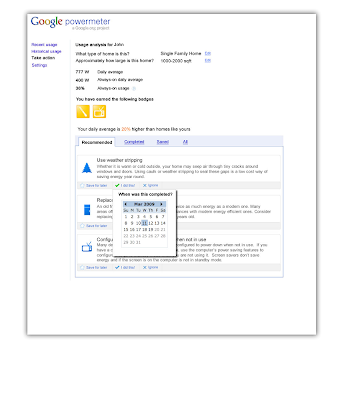
Google PowerMeter now offers personalized energy savings recommendations to help you save more energy and show off your savings. You can find it under “Take action” in your
Google PowerMeter
page.
Over time, the feature will provide even more useful tips. As your energy consumption behavior changes, you will receive new recommendations to help you save even more.
In addition to receiving customized energy saving recommendations, you’ll earn a special badge when you complete a recommendation. Collecting badges is a fun way of keeping track of your accomplishments to reduce energy waste and save money. And you might even strike up some friendly competition among family and friends to see who can collect the most badges the fastest!
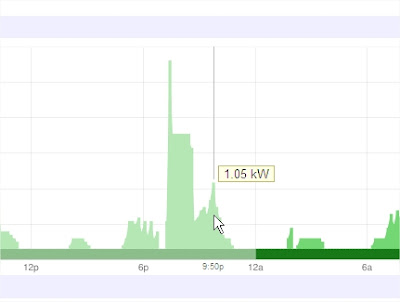
We’ve also made it easier to see how much energy you’re using with a new display feature on the Google PowerMeter chart. Now, when you move your cursor over the chart, you’ll see a pop-up that shows the amount of power used at that moment in time.
Stay tuned as we continue to develop new features for Google PowerMeter.
Posted by Ryan Falor, Product Manager, Google PowerMeter
Our Support for AB32 and a Clean Energy Future in California
8/10/10
We believe in
taking responsibility
for our carbon emissions and promoting sustainable environmental solutions. Today, we hosted an event with the Silicon Valley Leadership Group:
Electric Bills & Oil Spills: Will California Continue to be a Clean Energy Leader?
The discussion focused on AB32, California’s landmark legislation to reduce the state’s greenhouse gas emissions, and the future of the clean energy economy here in California and across the country.
California has led the nation in putting in place the right energy policies to foster growth in the clean energy economy. Google has been an early and strong supporter of AB32, legislation that creates jobs and spurs the development of clean energy technologies. In fact, last year, California's policies attracted
60 percent of all cleantech investment capital in North America
-- $2.1 billion. From 1995 to 2008, California has seen a
45 percent increase in green businesses, and a 36 percent expansion in green jobs
. That’s why we joined Californians for Clean Energy and Jobs, a coalition of businesses, NGOs, and labor organizations that support AB32.
Indeed, we believe our work in clean energy is good for business. We made the decision to become
carbon neutral
in 2007. We are minimizing our energy consumption with some of the most
energy efficient data centers
in the world, lowering our energy costs. And we are
purchasing carbon offsets
for the emissions we can’t eliminate. We also seek to power our facilities with renewable energy, like one of the largest corporate solar installations at our headquarters in Mountain View, CA. And we’re making investments in renewable energy, such as our
$38.8 million investment
in two North Dakota wind farms, and our recent agreement to purchase
114MW of wind energy over a 20 year period
, spurring real growth in the sector by giving the developer financial certainty to develop new projects.
As a technology company, we’ve seen how the power of innovation can change the way we live our lives. Eric Schmidt said it best: “In Silicon Valley, it was the limitations of one technology or system that served as the drivers of change and led to the success of our industries here. AB32 provides a similar opportunity for new job creation in many sectors as business responds to the need for energy-efficient buildings, transportation and a growing portfolio of renewable energy resources.”
We’re committed to finding the right solutions to a clean energy future and we hope California’s policies continue to lead the way.
Posted by Bill Weihl, Green Energy Czar
Reducing our carbon footprint with the direct purchase of renewable energy
7/20/10
(Cross-posted from the
Official Google Blog
to bring you information on other green efforts at Google)
When we decided in 2007 to
voluntarily become carbon neutral
, our intent was to take responsibility for our carbon emissions and promote sustainable environmental solutions. We approach this goal in three ways. First, we minimize our energy consumption; in fact, we’ve built some of the world’s most
energy efficient data centers
. Second, we seek to power our facilities with renewable energy, like we did in Mountain View, CA with
one of the largest corporate solar installations
. Finally, we
purchase carbon offsets
for the emissions we cannot directly eliminate.
We just completed a substantial 20-year green Power Purchase Agreement that allows us to take responsibility for our footprint and foster true growth in the renewable energy sector. On July 30 we will begin purchasing the clean energy from 114 megawatts of wind generation at the NextEra Energy Resources Story County II facility in Iowa at a predetermined rate for 20 years. Incorporating such a large amount of wind power into our portfolio is tricky (read more about
how the deal is structured
), but this power is enough to supply several data centers.
The wind farm, which began operation in December 2009, consists of 100 GE 1.5MW XLE turbines.
By contracting to purchase so much energy for so long, we’re giving the developer of the wind farm financial certainty to build additional clean energy projects. The inability of renewable energy developers to obtain financing has been a significant inhibitor to the expansion of renewable energy. We’ve been excited about this deal because taking 114 megawatts of wind power off the market for so long means producers have the incentive and means to build more renewable energy capacity for other customers.
We depend upon large quantities of electricity to power Google services and want to make large actions to support renewable energy. As we continue operating with the most energy efficient data centers and
working to be carbon neutral
, we’re happy to also be directly purchasing energy from renewable resources.
Posted by Urs Hoelzle, Senior Vice President, Operations
Largest supplier of energy monitors now compatible with Google PowerMeter
5/24/10
Today we are excited to offer a new way for many more people to access Google PowerMeter: our new Featured Device partner
Current Cost
- the largest global supplier of real time displays for monitoring energy use. Having already sold one million energy monitoring devices, Current Cost
will now offer devices
that are compatible with Google PowerMeter. They will also offer upgrades to existing customers so that they too can monitor their energy consumption anywhere online with our software.
Devices that integrate with Google PowerMeter will first be available in North America, the United Kingdom, Australia and New Zealand. Current Cost uses the Google PowerMeter API that
we released back in March
and
joins others
as a Featured Device partner that allows customers to understand their energy use. Our partnership is another example of hardware meeting our software to help customers save energy and money.
E.ON
, one of the UK’s largest utilities, has also teamed up with Current Cost to offer its customers a Google PowerMeter compatible energy monitor as part of its free “
Energy Fit Starter Pack
.”
Current Cost estimates that their customers have already saved close to 400,000 tons of CO2 through monitoring their electricity use. One Australian restaurant
recently learned
that something as easy as turning off their coffee pots each night would save them $3,000 dollars per year.
Curious how you can start saving?
Sign up
for Google PowerMeter today.
Posted by Scott Coleman, Partnership Development Manager, Google.org
Not merely tilting at windmills — investing in them too
5/3/10
(Cross-posted from the
Official Google Blog
to bring you information on other green efforts at Google)
On Friday we made our first direct investment in a utility-scale renewable energy project — two wind farms that generate 169.5 megawatts of power, enough to power more than 55,000 homes. These wind farms, developed by
NextEra Energy Resources
, harness power from one of the
world’s richest wind resources
in the North Dakota plains and use existing transmission capacity to deliver clean energy to the region, reducing the use of fossil fuels. Through this $38.8 million investment, we’re aiming to accelerate the deployment of renewable energy — in a way that makes good business sense, too.
To reach a clean energy future, we need three things: effective policy, innovative technology and smart capital. Through our philanthropic arm Google.org, we’ve been pushing for
energy policies
that strengthen the innovation pipeline, and we’ve been dedicating resources to developing
new technologies
, including making investments in early-stage renewable energy companies such as
eSolar
and
AltaRock
. Smart capital includes not only these early-stage company investments, but also dedicated funding for utility-scale projects. To tackle this need, we’ve been looking at investments in renewable energy projects, like the one we just signed, that can accelerate the deployment of the latest clean energy technology while providing attractive returns to Google and more capital for developers to build additional projects.
A clear windy day at the Ashtabula II wind farm
We’re excited about this first project investment because it uses some of the latest wind turbine technology and control systems to provide one of the lowest-cost sources of renewable energy to the local grid. The turbines can continuously adjust the individual blade pitch angles to achieve optimal efficiency and use larger blades with 15 percent more swept area than earlier generations, allowing capture of even more wind energy for each turbine. The control systems for these wind farms are also advanced and dynamic, allowing for remote 24/7 monitoring and operation to ensure maximum turbine up-time and power production. A couple of us got a chance to climb 80 meters up one of the 113 turbines to see firsthand how the rotating blade motion goes through a gearbox to turn the generator that makes the electricity. The climb to the top also provided a great view of the entire wind farm (don’t worry — we all had harnesses and turned the turbine off!).
My colleague Matt takes a rest after the 80-meter climb
We look forward to finding more opportunities to invest in renewable energy projects that use the latest technologies to push the envelope for delivering low cost clean energy. We’ll let you know what we find.
Posted by Rick Needham, Green Business Operations Manager
Archive
2016
Sep
Aug
Jul
Jun
Apr
Feb
2015
Dec
Nov
Oct
Sep
Aug
Jul
Feb
2014
Dec
Nov
Sep
Aug
Jul
Jun
May
Apr
Jan
2013
Nov
Oct
Sep
Aug
Jul
Jun
May
Apr
Mar
Jan
2012
Dec
Nov
Oct
Sep
Jul
Jun
May
Apr
Mar
Jan
2011
Dec
Oct
Sep
Aug
Jul
Jun
May
Apr
Mar
Feb
Jan
2010
Dec
Nov
Oct
Aug
Jul
May
Apr
Mar
Feb
Jan
2009
Dec
Nov
Oct
Aug
Jul
Jun
May
Apr
Mar
Feb
Jan
2008
Dec
Nov
Oct
Sep
Aug
Jul
Jun
May
Apr
Mar
Jan
2007
Dec
Nov
Oct
Sep
Aug
Jun
2006
Nov
Oct
Feed
Google
on
Follow @google
Follow
More Google Green
Google Green site
Google Data Centers site






 Follow