Green Blog
A better web. Better for the environment.
First solar-powered plane completes maiden round-the-world tour, setting 19 world records
7/25/16
Posted by Amy Atlas, Communications Lead for Google Green
At 4:05am local time today, an atypical plane landed on a tarmac in Abu Dhabi: Si2, a futuristic aircraft entirely powered by solar energy.
It was imagined and built by the two Swiss explorers Bertrand Piccard and André Borschberg, who founded Solar Impulse to promote the use of clean energies. They set the goal of circumnavigating the world by air, powered by the sun, with no fuel or polluting emissions. Starting in 2004, it took the team more than a decade to design and proof test this unique aircraft. Si2 took off in March 2015 for a 17-leg journey, spanning over 26,000 miles and using 11,000 kWh worth of solar energy. After 510 flying hours, Si2 has set 19 world records, according to the Fédération Aéronautique Internationale (FAI), on this historic expedition.
Google helped build and host Solar Impulse’s digital presence, and on the first day of their round-the-world journey, we jointly launched the
#FutureIsClean initiative
, a platform to encourage the world to support the adoption of necessary clean technologies.
We’re deeply committed to powering the world with clean energy. Our goal is
100% renewable power
, and so far we've committed to purchase nearly 2.5 gigawatts of renewable energy—equivalent to taking more than 1 million cars off the road—making us the largest non-utility purchaser of renewable energy in the world.
But commitment also comes through advocacy. That’s why in 2013, Google became the internet and technology partner of Solar Impulse: to raise awareness for what's possible with clean technology and renewable energy. Everybody could use the plane’s technologies on the ground to reduce our world’s energy consumption, save natural resources and improve our quality of life.
A global community formed to join the #FutureIsClean movement, following the progression of the Si2 during its travel around the world on
www.solarimpulse.com
, and tuning in for the pilot’s conversations with the Mission Control Center in Monaco (MCC). A virtual cockpit, built with the help of Google engineers and platforms, provided the telemetrics of Si2 (altitude, speed, battery level, equipment on board, etc.) and immersed children and supporters in the technical and human challenges that Solar Impulse embarked upon.
Today, we join the rest of the world in congratulating the Solar Impulse team for this outstanding accomplishment. Solar Impulse's pioneering spirit enabled them to push human boundaries and demonstrate that clean technologies can achieve goals we once thought were impossible.
DeepMind AI reduces energy used for cooling Google data centers by 40%
7/20/16
Posted by Rich Evans, Research Engineer, DeepMind and Jim Gao, Data Center Engineer, Google
From smartphone assistants to image recognition and translation, machine learning already helps us in our everyday lives. But it can also help us to tackle some of the world’s most challenging physical problems -- such as energy consumption. Large-scale commercial and industrial systems like data centers consume a lot of energy, and while much has been done to
stem the growth of energy use
, there remains a lot more to do given the world’s increasing need for computing power.
Reducing energy usage has been a major focus for us over the past 10 years: we have built our own
super-efficient servers
at Google, invented
more efficient ways to cool our data centers
and invested heavily in
green energy sources
, with the goal of being powered 100 percent by renewable energy. Compared to five years ago, we now get around 3.5 times the computing power out of the same amount of energy, and we continue to make many improvements each year.
Major breakthroughs, however, are few and far between -- which is why we are excited to share that by applying DeepMind’s machine learning to our own Google data centers, we’ve managed to reduce the amount of energy we use for cooling by up to 40 percent. In any large scale energy-consuming environment, this would be a huge improvement. Given how sophisticated Google’s data centers are already, it’s a phenomenal step forward.
The implications are significant for Google’s data centers, given its potential to greatly improve energy efficiency and reduce emissions overall. This will also help other companies who run on Google’s cloud to
improve their own energy efficiency
. While Google is only one of many data center operators in the world, many are
not
powered by renewable energy as we are. Every improvement in data center efficiency reduces total emissions into our environment and with technology like DeepMind’s, we can use machine learning to consume less energy and help address one of the biggest challenges of all -- climate change.
One of the primary sources of energy use in the data center environment is cooling. Just as your laptop generates a lot of heat, our data centers -- which contain servers powering Google Search, Gmail, YouTube, etc. -- also generate a lot of heat that must be removed to keep the servers running. This cooling is typically accomplished via large industrial equipment such as pumps, chillers and cooling towers. However, dynamic environments like data centers make it difficult to operate optimally for several reasons:
The equipment, how we operate that equipment, and the environment interact with each other in complex, nonlinear ways. Traditional formula-based engineering and human intuition often do not capture these interactions.
The system cannot adapt quickly to internal or external changes (like the weather). This is because we cannot come up with rules and heuristics for every operating scenario.
Each data center has a unique architecture and environment. A custom-tuned model for one system may not be applicable to another. Therefore, a general intelligence framework is needed to understand the data center’s interactions.
To address this problem, we began applying
machine learning
two years ago to operate our data centers more efficiently. And over the past few months, DeepMind researchers began working with Google’s data center team to significantly improve the system’s utility. Using a system of neural networks trained on different operating scenarios and parameters within our data centers, we created a more efficient and adaptive framework to understand data center dynamics and optimize efficiency.
We accomplished this by taking the historical data that had already been collected by thousands of sensors within the data center -- data such as temperatures, power, pump speeds, setpoints, etc. -- and using it to train an ensemble of deep neural networks. Since our objective was to improve data center energy efficiency, we trained the neural networks on the average future PUE (Power Usage Effectiveness), which is defined as the ratio of the total building energy usage to the IT energy usage. We then trained two additional ensembles of deep neural networks to predict the future temperature and pressure of the data center over the next hour. The purpose of these predictions is to simulate the recommended actions from the PUE model, to ensure that we do not go beyond any operating constraints.
We tested our model by deploying on a live data center. The graph below shows a typical day of testing, including when we turned the machine learning recommendations on, and when we turned them off.
Google DeepMind graph showing results of machine learning test on power usage effectiveness in Google data centers
Our machine learning system was able to consistently achieve a 40 percent reduction in the amount of energy used for cooling, which equates to a 15 percent reduction in overall PUE overhead after accounting for electrical losses and other non-cooling inefficiencies. It also produced the lowest PUE the site had ever seen.
Because the algorithm is a general-purpose framework to understand complex dynamics, we plan to apply this to other challenges in the data center environment and beyond in the coming months. Possible applications of this technology include improving power plant conversion efficiency (getting more energy from the same unit of input), reducing semiconductor manufacturing energy and water usage, or helping manufacturing facilities increase throughput.
We are planning to roll out this system more broadly and will share how we did it in an upcoming publication, so that other data center and industrial system operators -- and ultimately the environment -- can benefit from this major step forward.
More Nordic wind power for our European data centers
6/29/16
Posted by Marc Oman, EU Energy Lead, Google Global Infrastructure
At the end of last year, we
announced
that we were purchasing a whopping 842 megawatts (MW) of additional renewable energy to power our operations and take us one step closer to running 100 percent of our operations on clean energy. Today, we walked further down that path by agreeing to purchase an additional 236 MW of energy from two new wind farms in Norway and Sweden.
These new Nordic power purchase agreements complement our three other Swedish wind deals and enable us to power even more of our European operations with renewable energy. In total, we now have seven purchase agreements in Europe, totalling more than 500 MW and 18 such deals globally, which means we’ve now purchased nearly 2.5 gigawatts (GW) worldwide – the equivalent of taking over 1 million cars off the road.
As with our other power purchase agreements, we’re buying the entire production of these new wind farms, situated in two great areas for onshore wind in Europe. In Norway, power will be generated by a 50-turbine project near Stavanger, which is set to be completed in late 2017. In Sweden, we’re buying power from a 22-turbine project, near Mariestad and Töreboda, which will be completed by early 2018. In both cases, we’ve signed long-term contracts that give us price certainty and help wind farm developers secure construction financing, in these cases from companies like
Blackrock
and
Ardian
.
One of our key goals is to enable the addition of new renewable energy generation capacity to the grid, rather than drawing power from existing facilities. And thanks to Europe’s increasingly integrated energy market, we’re able to buy wind energy in Norway and Sweden, and consume it elsewhere in Europe.
We’ve known for a long time that
reducing energy usage
and using renewables makes good business sense - we signed our first major power purchase agreement for
114 MW of Iowa wind
in 2010. Others are discovering the benefits of renewables too - in the US alone, companies bought almost
3.5 GW of renewable energy last year
. We’re pleased to have played a part in stimulating the market for corporate renewable energy purchasing and doing our share in the effort to mitigate climate change.
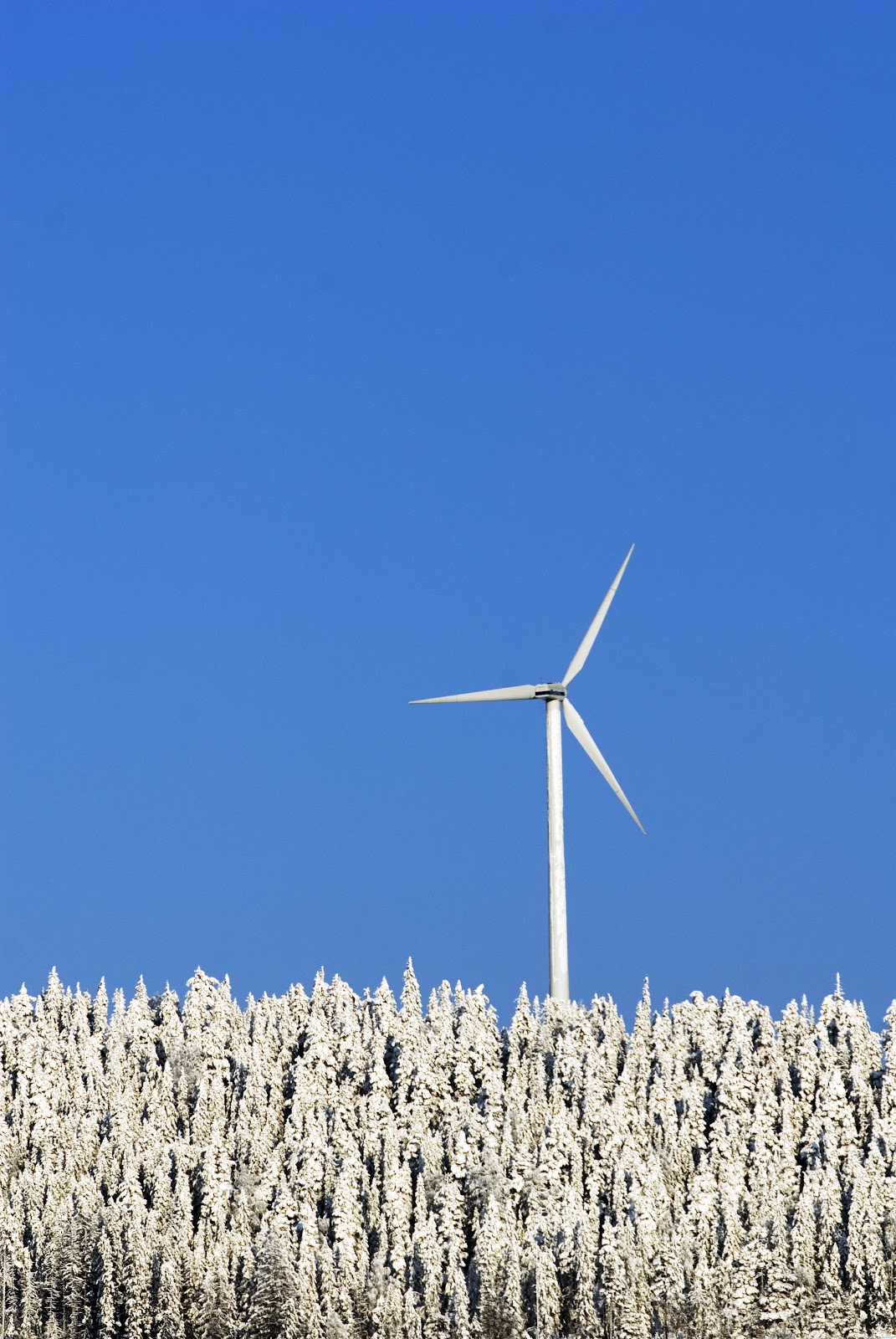
Photo of wind turbine in Sweden by BMJ via Shutterstock
Data Centers Get Fit on Efficiency
6/27/16
Post content
Posted by Urs Hölzle, Senior Vice President for Technical Infrastructure
Google’s efforts to build the world’s most efficient data centers are beginning to give back -- in energy. A
study
just released by the U.S. Department of Energy’s Lawrence Berkeley National Laboratory (Berkeley Lab) shows that in the last five years, data center efficiency has kept energy usage almost flat despite a huge growth in demand for computing power.
In fact, compared to five years ago, we can now deliver over 3.5 times as much computing power for the same amount of electrical power. That means that even though we’re sending more email, watching more YouTube videos, and saving more digital photos, we’re using the same amount of energy.
Let’s dig into some numbers from the
report
:
In 2014, U.S. data centers used 70 billion kWh of energy -- equal to powering more than six million homes for a year.
This is a big shift in energy consumption:
From 2000 to 2005, usage grew 90 percent;
From 2005 to 2010, usage grew 24 percent;
From 2010 to 2014, usage grew 4 percent.
Energy use is expected to increase at the same rate of four percent from 2014 to 2020.
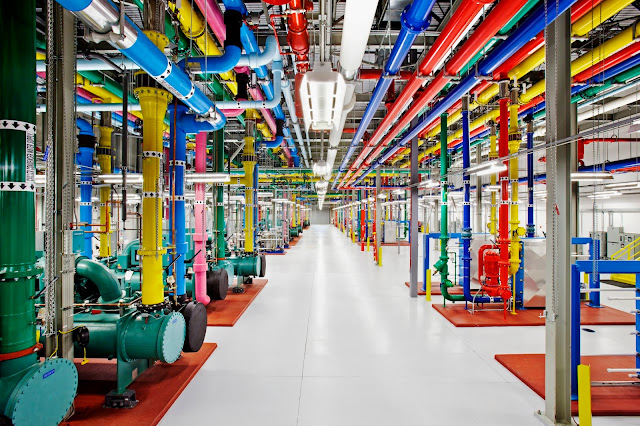
Inside a Google data center
Stabilizing data center energy usage is great, but at Google, we believe we will
go further than simply stopping the growth
. As more IT users transition to public clouds and mobile use increases, total energy usage will likely go down even more. On the server side, ultra-efficient cloud capacity replaces older, less efficient corporate data centers, and on the client side, battery life pressures ensure that mobile devices use much less energy than desktops.
The cloud supports many products at a time, so it can more efficiently distribute resources among many users. That means we can do more with less energy—and businesses can too. In 2013, the Berkeley Lab
published research
we helped support, indicating that moving all office workers in the United States to the cloud could reduce the energy used by information technology by up to 87 percent. That’s equal to powering the city of Los Angeles for one year.
2013 U.S. Case Study: Energy Efficiency Potential of Cloud-based Software (Berkeley Lab)
Efficiency in data center operations like Google’s comes from shifting to super efficient computing, along with improvements in storage, network and infrastructure, employing more advanced cooling strategies, better power management software, and consolidating servers.
We are focused on creating platforms where everyone can benefit. Google builds hyperscale data centers that are designed to maximize infrastructure efficiency. We also began publishing our
efficiency data
in 2008 and have been promoting techniques for more efficient energy use to leaders in the IT industry, starting with the first
data center efficiency summit
in 2009 and our continued advances with
machine learning
.
These results show the rapid impact efficiency can have on the industry and the persistent opportunity we have to reduce energy use while creating a more powerful web.
Innovating for a Cleaner Energy Future
6/2/16
Energy ministers from around the globe visited the Bay Area this week for their first meeting following the signing of historic
climate change agreements
in France last year. The focus of the annual gathering for the seventh
Clean Energy Ministerial
, known as CEM7, was to discuss how to achieve the goals set in the Paris climate change deal as well as see some of the innovations coming out of Silicon Valley to tackle the issue head on.
A number of ministers embarked on a fact finding mission that included Google where they came to learn at first hand about our approach and commitment to clean energy and the climate.
Senior Vice President for Technical Infrastructure
Urs Hölzle
told the group that renewable energy is critical for businesses like ours -- from powering our data centers to our products and services.
“ Having pioneered some of the first corporate renewable power purchasing back in 2010-2011, we’re excited to see that this is becoming business-as-usual for companies everywhere. And at Google we continue to be committed to 100% renewable energy because this makes good business sense and is the right thing to do for the planet and for our users.”
US Energy Secretary Ernest Moniz who led the visit to Google was joined by ministers and officials from countries like the Netherlands, Denmark, Germany, Italy, Chile, India, Indonesia, and South Africa.
The group got the opportunity to see at first hand a number of projects aimed at everything from helping people make smart choices about
solar power
to how we power our
data centers
with renewable energy, and from advancing new approaches to
wind power
to helping consumers
save energy in the home
and the benefits of
self driving cars
.
Self-driving cars could reduce the energy intensity per vehicle through a combination of more efficient vehicle designs, driving behaviors, routing, power usage, and capabilities for vehicles to drive closer to each other, according to
U.S. Department of Energy, 2014
.
In an effort to build on this week’s momentum the CEM launched a campaign that will promote solutions that enable more companies to purchase renewable power. As part of this effort, Google has agreed later this year to host national governments, renewable energy buyers and suppliers, NGOs, and other interested groups as they look for ways to further unlock corporate renewable energy demand in CEM countries.
Mars Hanna, Global Energy Policy and Strategy
Laying the Foundation for Renewable Energy Certification Programs in Asia
4/6/16
At Google, we’ve made a
long term commitment
to power 100% of our operations with renewable energy. To that end, we’ve
purchased more than 2 gigawatts of renewable energy
to date, making us the world’s largest non-utility purchaser of renewables.
Our
data centers
– including our facilities in
Taiwan
and
Singapore
that help us provide people in Asia with faster, more reliable access to our tools and services – make up the majority of our electricity consumption. We are
working to power all of our data centers around the world with renewable energy
, but one of the challenges we face in Asia is that effective renewable energy certification programs simply aren’t available.
To help address this, we’re announcing today that we’re providing seed funding to the
Center for Resource Solutions
(CRS) to begin laying the groundwork to establish such programs across Asia, starting in Taiwan. They have over 20 years of experience developing and operating renewable energy certification programs.
These kinds of programs are key in helping companies like Google actually know that the power we are buying comes from a renewable source. They work by “tagging” each MWh of energy generated from a source like wind or solar as renewable, which creates a renewable energy certificate (“REC”). This is especially important to us in Taiwan, where we are actively looking to purchase renewable energy for our data center.
The
video below
from CRS explains how this works for some customers. In Google’s case, we buy both the physical power and the RECs associated with that power, providing us with both the financial benefits of renewable energy and the assurance that the electricity we are buying is in fact renewable.
It may not sound like much, but these programs are critical to creating well-functioning voluntary renewable energy markets. For the
dozens of Fortune 100 and Global 100 companies that have renewable energy commitments
, RECs are a critical instrument to ensuring that renewable energy purchasing claims are accurate and verifiable. They have played a key role in enabling companies in the United States to grow their renewable energy purchasing from about 100 MW in 2012 to over
3,000 MW last year
.
With this support from Google, CRS will begin examining how best to structure these programs across Asia to create robust voluntary renewable energy markets. They will also begin building a coalition of international stakeholders from the public, private, and NGO sectors to drive these efforts forward.
Organizations interested in supporting these efforts may get
more information here.
Posted by Marsden Hanna, Global Energy Policy and Strategy
Google unites with other tech companies to support US Clean Power Plan.
4/1/16
Today Google, along with Amazon, Apple and Microsoft, filed a legal brief with the DC Circuit Court supporting the
Environmental Protection Agency’s Clean Power Plan.
The CPP aims to accelerate the transition to cleaner sources of electricity and puts an emphasis on renewable energy development and energy efficiency. The plan has been put on hold pending the outcome of a legal challenge.
Google, Amazon, Apple and Microsoft have come together in
this brief
to offer our unique view as large consumers of energy. Collectively we used 10 million MWh of electricity last year, including at 50 data centers in 12 states. That means reliable and affordable electricity is integral to the continued growth and operation of all of our businesses and the services we offer to our users everywhere. We are all committed to sourcing our power in a sustainable way, and renewable energy makes good business sense for us all.
At Google, we have been
carbon neutral since 2007
. We have signed contracts to
purchase over 2GW of renewable energy
-- equivalent to taking nearly one million cars off the road -- making us the largest non-utility renewable energy purchaser in the world. Just last year we signed the
largest and most diverse purchase of renewable energy
made by a non-utility company to power our data centers. The deal covers a series of new wind and solar projects around the world and takes us one step closer to our goal of powering 100% of our operations with clean energy. Above and beyond our own power purchases, we have also invested
more than $2.5 billion in 22 other renewable projects
around the world.
These efforts underline the seriousness of our
commitment to renewables
and we believe the CPP is an important step in the transition to a cleaner energy future. The message from our companies today is clear -- we can meet the world’s future energy challenges in a way that drives innovation and growth while tackling climate change.
Posted by Michael Terrell, Principal, Energy and Global Infrastructure.
Archive
2016
Sep
Aug
Jul
Jun
Apr
Feb
2015
Dec
Nov
Oct
Sep
Aug
Jul
Feb
2014
Dec
Nov
Sep
Aug
Jul
Jun
May
Apr
Jan
2013
Nov
Oct
Sep
Aug
Jul
Jun
May
Apr
Mar
Jan
2012
Dec
Nov
Oct
Sep
Jul
Jun
May
Apr
Mar
Jan
2011
Dec
Oct
Sep
Aug
Jul
Jun
May
Apr
Mar
Feb
Jan
2010
Dec
Nov
Oct
Aug
Jul
May
Apr
Mar
Feb
Jan
2009
Dec
Nov
Oct
Aug
Jul
Jun
May
Apr
Mar
Feb
Jan
2008
Dec
Nov
Oct
Sep
Aug
Jul
Jun
May
Apr
Mar
Jan
2007
Dec
Nov
Oct
Sep
Aug
Jun
2006
Nov
Oct
Feed
Google
on
Follow @google
Follow
More Google Green
Google Green site
Google Data Centers site






 Follow