Green Blog
A better web. Better for the environment.
An energetic welcome to Arun Majumdar
12/17/12
One of the world’s biggest challenges is bringing reliable, sustainable and affordable energy to everyone. We need a new energy blueprint for the future—the latest advances in technology have the potential to bring us closer to that goal than ever before.
That’s why I’m pleased to welcome Dr. Arun Majumdar to Google, where he will drive Google.org’s energy initiatives and advise the company on our broader energy strategy. Arun is widely recognized as one of the foremost leaders in energy innovation. He joins us from the Department of Energy, where he served as Acting Undersecretary of Energy and was founding Director of the Advanced Research Projects Agency—Energy (better known as ARPA-E), identifying and providing essential support for the development of transformational new energy technologies. In his roles at Lawrence Berkeley National Laboratory and the University of California at Berkeley, he made great contributions in the areas of energy conversion, transport, and storage, and in 2005 was elected a member of the National Academy of Engineering.
We’re looking forward to great things in the coming year with Arun’s leadership and experience on the team.
Posted by Matthew Stepka, VP, Google.org
Growing green communities on Google+
12/14/12
All around Google+, people are gathering together to talk about things that matter to them, including the environment.
Since we launched
Google+ Communities
a week ago, it's been great to see how quickly green communities have sprouted up.
With Google+ communities, you can:
Join public communities on everything from
vegetarian cooking
to
backyard farming
Create private communities like a bike-to-work group among your coworkers or a freecycling group among your friends
Browse discussion categories to find the conversations you care about most (like whether the future of renewable energy lies in
solar
or
wind
)
Start hangouts and plan events with community members
Some of our favorite green communities on Google+ so far:
Because shared information can help people make greener choices, and because lively online discussions can inspire real-life action, we're excited about this new feature. Explore different communities on Google+ and see what people are doing to create more green in the world—this holiday season and through the new year.
Posted by Therese Wong, Google Green team
Getting the heat out: A look at evaporative cooling
11/19/12
When our data centers are answering your search queries and streaming YouTube videos, they’re generating heat. We wrote about our hot hut infrastructure which pulls heat from our servers in an
earlier blog post
, but how do we efficiently get that heat out of the building?
Cooling towers, like those pictured below, expose water heated by the data center floor to the outside air. In the same way that perspiration removes heat from the human body, we use water evaporation to cool the water that runs through our data centers. This allows us to use the ‘free cooling’ provided by the local climate.
Rooftop cooling towers
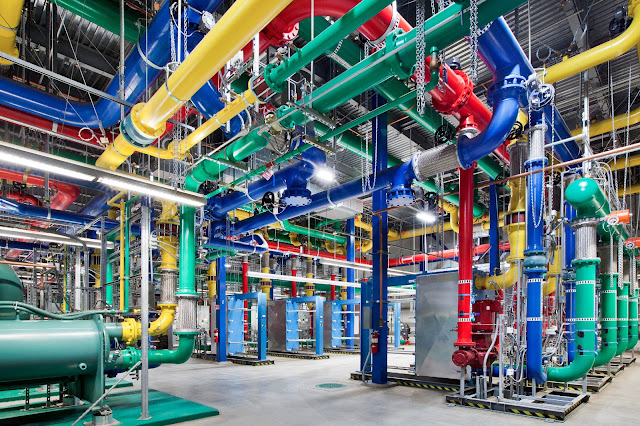
We use two loops of water to remove heat from the data center floor and transfer it to our cooling towers. Red (hot) and blue (cold) pipes carry water to and from the data center floor. Yellow (hot) and green (cold) pipes carry water to and from the cooling towers on the roof. The photo below shows our heat exchangers, where these two loops of water meet. The colorful pipes aren’t just for decoration, they designate the hot and cold water traveling in each of the loops. It is a happy coincidence that our company colors worked so well for labeling our water pipes.
Heat exchanger room
In some sites with hot summer climates, we have backup chillers on hand (the double-barreled green units on the left side of the photo)—just in case the temperature or humidity gets too hot to rely on our cooling towers. We only use these when absolutely necessary, since they’re not as efficient as using outside air for cooling.
We aim to use as little energy as possible to power our products, and our cooling towers are a critical part of this effort. Learn more about how we cool our data centers on our
Data center site
.
Posted by Joe Kava, Vice President, Data Center Operations
Investing in green energy in Greene County, Iowa
11/15/12
(Cross-posted from the
Official Google Blog
)
If you drive northwest from Des Moines, Iowa, you’ll see a lot of corn fields. From time to time, you’ll also see wind turbines rising out of those fields, making efficient use of our natural resources to produce renewable energy. It’s places like these that are home to a vibrant, emerging clean energy economy.
Today we‘re announcing that we’ve made an equity investment of $75 million in a 50MW wind farm in Rippey, a small town in Greene County, about an hour outside of Des Moines. The Rippey project, developed by
RPM Access
, is expected to produce enough energy to power over 15,000 Iowa homes. The project, which is now in operation, uses turbines produced by
Nordex USA
at their Jonesboro, Ark. facility.
Investment team members Nick Coons and Steffi Russell-Egbert visiting the Rippey project on a (windy) day in October.
We’ve taken two approaches to greening the grid in Iowa, a state where we
operate a data center
. Back in 2010,
we entered into
a long-term contract to purchase wind energy from NextEra Energy Resources’ Story County II wind farm. This time, we’re investing directly into a wind project, which has been contracted to sell all of the energy to the
Central Iowa Power Cooperative
, an Iowa-based utility that will deliver the energy to local consumers. We’re happy to help make more renewable energy available to Iowans and to support the growing wind energy industry in the state.
This project brings our committed investment to the renewable energy sector to more than $990 million. Read more about our previous investments on our
Google Green site
.
Posted by Axel Martinez, Assistant Treasurer, Head of Capital Markets
A healthy grant to support healthy buildings
11/14/12
(Cross-posted from the
Official Google Blog
)
Imagine having nutrition-label-like data about every product you use at your fingertips—knowing exactly what ingredients make up things like office chairs or house paint and how they could impact your health today and 30 years from now. It’s a future that goes hand in hand with our commitment to
creating the healthiest work environments possible
and promoting transparency within the wide world of building materials.
Today, we’re taking a step toward that future with a $3 million grant to the
U.S. Green Building Council (USGBC)
, a leading non-profit organization that works to create greener buildings and communities in the U.S. and around the world.
There’s a lack of clear and accessible information on building ingredients, which means that a lot of us might be exposed to potentially harmful and toxic chemicals in building materials—whether it’s in the desk you sit at every day or the building’s paints, tiles and carpeting. This grant is designed to improve human health and well-being by supporting more industry research and better standards around healthy materials.
We’ve
already done a lot
to eliminate many of these chemicals in our offices around the world, and we want to make it easier for others to do the same. The USGBC has had great success with their widely adopted
LEED
(Leadership in Energy and Environmental Design) rating system for the design, construction and operation of green buildings. LEED is certifying 1.7 million square feet every day with 9.3 billion square feet participating in LEED across all 50 states and 138 countries. We think they’re in a great position to build on this track record to create real and lasting change in the industry.
But it isn't enough just to have better labeling or standards about the ingredients in various products. We also need to know more about the ingredients themselves, which is why this grant also supports more scientific research and outreach so we can all do a better job of understanding how building materials impact human health. By doing so, we hope to empower consumers and businesses alike to make more informed decisions about the materials they purchase and use in their day-to-day lives.
Posted by Lacy Caruthers, Sustainability Team
Cooling the cloud: A look inside Google’s Hot Huts
10/23/12
If you’ve taken a look at our new site,
Where the Internet lives
, you’ve gotten an in-depth look at some of our infrastructure and the people who help keep Google up and running for you. Our
data center infrastructure
is the foundation for all Google services, powering our servers, networking equipment and cooling systems.
Our emphasis on cooling systems might come as a surprise, until you consider how warm a personal computer can become during use. Data centers, which house thousands of computers, need to stay within a specific operating temperature range. Even though we run our facilities
hotter than a typical data center
, we need cooling systems - both to prevent server breakdowns and to provide a reasonable working environment for technicians working on the data center floor.
After servers, the second largest consumer of power in a data center is the cooling system. We needed a cooling system which minimized our overall energy consumption. For this reason, we designed our own cooling systems from the ground up.
This photo shows several of our custom cooling systems arranged in a row with racks of servers pushed against them on both sides. We named these units “Hot Huts” because they are sealed from the rest of the data center floor. Sealing away the hot air increases cooling efficiency.
The interior of a hot hut row
The black circles along the walls in the photograph above are the exhaust fans on our server trays, and the hoses coming up from the floor contain water going to and from the cooling coils in the top of each unit. Fans on top of each Hot Hut pull hot air across these water-filled cooling coils. This cooled air leaving the Hot Hut returns to the ambient air in the data center, and machines can draw in this air again to cool themselves down, completing the cooling cycle.
Set of active racks pushed up against hot huts
We chose a water-based cooling system for our data centers
since water can hold more heat than air
. Water-based cooling means running pipes under the raised floors in our data centers. With so much electrical equipment in place, we take precautions with regular inspections and an alarm system which detects leaks. Here, a data center technician inspects underfloor water pipes which lead to a heat exchanger in the cooling plant.
Inspecting underfloor pipes
By providing this view into our data center operations, we hope to inspire other companies to rethink their approaches to data center cooling. Building our own cooling systems means we can keep our data centers cool using a fraction of the energy used by a typical data center chiller, and that translates to reliable, carbon neutral services you can use for free.
Posted by Joe Kava, Senior Director, Data Center Operations
Google’s data centers: an inside look
10/17/12
(Cross-posted from the
Official Google Blog
)
Very few people have stepped inside Google’s data centers, and for good reason: our first priority is the privacy and security of your data, and we go to great lengths to protect it, keeping our sites under close guard. While we’ve shared many of our
designs and best practices
, and we’ve been
publishing our efficiency data since 2008
, only a small set of employees have access to the server floor itself.
Today, for the first time, you can see inside our data centers and pay them a virtual visit. On
Where the Internet lives
, our new site featuring beautiful photographs by
Connie Zhou
, you’ll get a never-before-seen look at the technology, the people and the places that keep Google running.
The server floor in Council Bluffs, Iowa
Night falls over our Lenoir, NC data center
In addition, you can now explore our Lenoir, NC data center at your own pace in Street View. Walk in the
front door
, head up the stairs, turn right at the ping-pong table and head down the hall to the
data center floor
. Or take a stroll around the
exterior
of the facility to see our energy-efficient cooling infrastructure. You can also watch a video tour to learn more about what you're viewing in Street View and see some of our equipment in action.
Finally, we invited author and
WIRED
reporter
Steven Levy
to talk to the architects of our infrastructure and get an unprecedented look at its inner workings. His
new story
is an exploration of the history and evolution of our infrastructure, with a first-time-ever report from the floor of a Google data center.
Fourteen years ago, back when Google was a student research project, Larry and Sergey powered their new search engine using a few cheap, off-the-shelf servers stacked in
creative ways
. We’ve grown a bit since then, and we hope you enjoy this glimpse at what we’ve built. In the coming days we’ll share a series of posts on the
Google Green Blog
that explore some of the photographs in more detail, so stay tuned for more!
Posted by Urs Hölzle, Senior Vice President, Technical Infrastructure
Archive
2016
Sep
Aug
Jul
Jun
Apr
Feb
2015
Dec
Nov
Oct
Sep
Aug
Jul
Feb
2014
Dec
Nov
Sep
Aug
Jul
Jun
May
Apr
Jan
2013
Nov
Oct
Sep
Aug
Jul
Jun
May
Apr
Mar
Jan
2012
Dec
Nov
Oct
Sep
Jul
Jun
May
Apr
Mar
Jan
2011
Dec
Oct
Sep
Aug
Jul
Jun
May
Apr
Mar
Feb
Jan
2010
Dec
Nov
Oct
Aug
Jul
May
Apr
Mar
Feb
Jan
2009
Dec
Nov
Oct
Aug
Jul
Jun
May
Apr
Mar
Feb
Jan
2008
Dec
Nov
Oct
Sep
Aug
Jul
Jun
May
Apr
Mar
Jan
2007
Dec
Nov
Oct
Sep
Aug
Jun
2006
Nov
Oct
Feed
Google
on
Follow @google
Follow
More Google Green
Google Green site
Google Data Centers site









 Follow