Green Blog
A better web. Better for the environment.
A proud partner in the Workplace Charging Challenge
1/31/13
At Google, we believe that plug-in vehicles are game-changers in the effort to reduce the carbon footprint of transportation, improve air quality, and increase the adoption of intermittent renewable energy sources. That’s why we’re excited to join the U.S. Department of Energy’s
Workplace Charging Challenge
, an initiative to increase the number of employers offering workplace charging by tenfold in five years.
Google has been dedicated to the
promise of electric vehicles
since 2007, when we outfitted a small fleet of Priuses and Escape Hybrids with homegrown dataloggers and installed an EV solar carport at our HQ in Mountain View. Our employees eagerly adopted the new technology, and we soon launched a corporate carshare program, called
GFleet
. GFleet provides Googlers with a low-carbon transportation option once they get to the office using alternative transportation (for instance, the Google shuttle, walking, biking, or carpooling). To date Googlers have driven GFleet vehicles over a quarter of a million miles.
To support GFleet and encourage Googlers to buy their own plug-ins, Google offers free on campus charging in Mountain View and eight additional office locations in the U.S. Now with more than 300 stations across the country, we’ve built the largest corporate charging infrastructure in the country.
We’re delighted to help drive progress in this space, and invite others to join the charge towards more EV infrastructure, cleaner air, and a sustainable future.
Posted by Rolf Schreiber, Technical Program Manager, Electric Transportation
Paving a path to intelligent energy use
1/14/13
One of the best parts about working at Google is the chance to use the Internet and digital technology to help us all manage energy better. We’ve seen big changes in recent years to the way we watch TV, use phones, read and listen to music, yet how we use electricity hasn’t changed much in decades.
What if instead of a monthly bill we had access to more real-time and actionable information about our electricity consumption? What if our appliances, air conditioners, and lights adjusted automatically to use energy more efficiently and save money? If we did this in every home it would help improve the reliability of the grid and save billions of dollars.
Technology like
smart meters
and
programmable thermostats
make it possible to do this today. The challenge is that the rules governing electricity distribution were written for last century’s grid. That’s why
Google.org
is giving a $2.65M grant to the
Energy Foundation
to support policy reforms that will lead to more intelligent energy use. The effort will focus on three fundamental areas:
Smarter electricity rates that encourage consumers to be more efficient, shift their electricity use to times when it’s cheaper and produce their own on-site energy;
Access to electricity markets for consumers and other businesses so they can be compensated for cutting energy use at key times; and
Open data policies that give customers access to their own energy data, which they can use or share with third parties they select, promoting better energy management tools and services.
These policy reforms, coupled with the new technologies now being deployed on a large scale, can empower consumers to make smarter energy choices, improve real-time management of the electricity grid, and help facilitate more renewable energy all while lowering overall costs.
We hope this grant will help catalyze change and look forward to seeing progress in the years to come.
Posted by Michael Terrell, Senior Policy Counsel, Energy & Sustainability
A wind investment deep in the heart of Texas
1/9/13
(Cross-posted from the
Official Google Blog
)
In late December, while most of us were busy wrapping presents, our Treasury team was tying a bow on our most recent
renewable energy deal
: an approximately $200 million equity investment in a wind farm in west Texas that generates enough energy to power more than 60,000 average U.S. homes.
Spinning Spur Wind Project is located in Oldham County, a wide open, windy section of the Texas Panhandle located about 35 miles from Amarillo. The 161 megawatt facility was built by renewable energy developer EDF Renewable Energy, a veteran in the industry that has overseen more than 50 other clean energy projects. Spinning Spur’s 70 2.3 MW Siemens turbines started spinning full time just before the end of the year, and the energy they create has been contracted to SPS, a utility that primarily serves Texas and New Mexico.
We look for projects like Spinning Spur because, in addition to creating more renewable energy and strengthening the local economy, they also make for smart investments: they offer attractive returns relative to the risks and allow us to invest in a broad range of assets. We’re also proud to be the first investor in an EDF Renewable Energy project that is not a financial institution, as we believe that corporations can be an important new source of capital for the renewable energy sector.
Spinning Spur joins
10 other renewable energy investments
we’ve made since 2010, several of which hit significant milestones in the past year:
The
Atlantic Wind Connection
received permission to begin permitting, an important step in advancing the construction of the United States’ first offshore backbone electric transmission system (more in this
new video
).
Shepherds Flat
, one of the world’s largest wind farms with a capacity of 845 MW, became fully operational in October.
The
Ivanpah
project, which is more than 75 percent complete and employs 2,000+ people, recently installed its 100,000th heliostat, a kind of mirror (more in this
new video
).
Just yesterday
(PDF), the fourth and final phase of Recurrent Energy's 88MW solar installation in Sacramento County, Calif., reached commercial operation.
Altogether, the renewable energy projects we’ve invested in are capable of generating 2 gigawatts of power. To give a better sense of what that really means, we came up with some comparisons (click to enlarge):
Here’s to a clean, renewable 2013!
Posted by Kojo Ako-Asare, Senior Manager, Corporate Finance
An energetic welcome to Arun Majumdar
12/17/12
One of the world’s biggest challenges is bringing reliable, sustainable and affordable energy to everyone. We need a new energy blueprint for the future—the latest advances in technology have the potential to bring us closer to that goal than ever before.
That’s why I’m pleased to welcome Dr. Arun Majumdar to Google, where he will drive Google.org’s energy initiatives and advise the company on our broader energy strategy. Arun is widely recognized as one of the foremost leaders in energy innovation. He joins us from the Department of Energy, where he served as Acting Undersecretary of Energy and was founding Director of the Advanced Research Projects Agency—Energy (better known as ARPA-E), identifying and providing essential support for the development of transformational new energy technologies. In his roles at Lawrence Berkeley National Laboratory and the University of California at Berkeley, he made great contributions in the areas of energy conversion, transport, and storage, and in 2005 was elected a member of the National Academy of Engineering.
We’re looking forward to great things in the coming year with Arun’s leadership and experience on the team.
Posted by Matthew Stepka, VP, Google.org
Growing green communities on Google+
12/14/12
All around Google+, people are gathering together to talk about things that matter to them, including the environment.
Since we launched
Google+ Communities
a week ago, it's been great to see how quickly green communities have sprouted up.
With Google+ communities, you can:
Join public communities on everything from
vegetarian cooking
to
backyard farming
Create private communities like a bike-to-work group among your coworkers or a freecycling group among your friends
Browse discussion categories to find the conversations you care about most (like whether the future of renewable energy lies in
solar
or
wind
)
Start hangouts and plan events with community members
Some of our favorite green communities on Google+ so far:
Because shared information can help people make greener choices, and because lively online discussions can inspire real-life action, we're excited about this new feature. Explore different communities on Google+ and see what people are doing to create more green in the world—this holiday season and through the new year.
Posted by Therese Wong, Google Green team
Getting the heat out: A look at evaporative cooling
11/19/12
When our data centers are answering your search queries and streaming YouTube videos, they’re generating heat. We wrote about our hot hut infrastructure which pulls heat from our servers in an
earlier blog post
, but how do we efficiently get that heat out of the building?
Cooling towers, like those pictured below, expose water heated by the data center floor to the outside air. In the same way that perspiration removes heat from the human body, we use water evaporation to cool the water that runs through our data centers. This allows us to use the ‘free cooling’ provided by the local climate.
Rooftop cooling towers
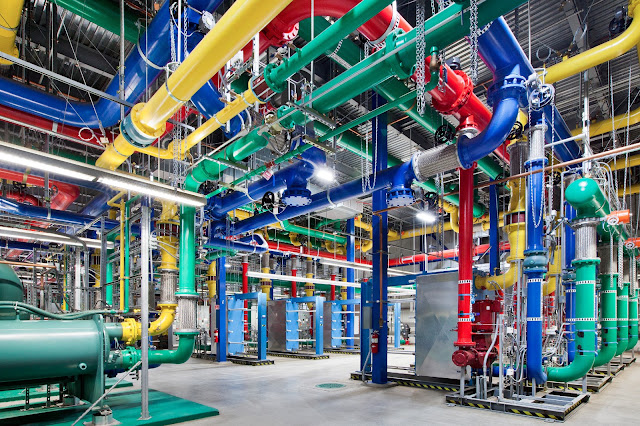
We use two loops of water to remove heat from the data center floor and transfer it to our cooling towers. Red (hot) and blue (cold) pipes carry water to and from the data center floor. Yellow (hot) and green (cold) pipes carry water to and from the cooling towers on the roof. The photo below shows our heat exchangers, where these two loops of water meet. The colorful pipes aren’t just for decoration, they designate the hot and cold water traveling in each of the loops. It is a happy coincidence that our company colors worked so well for labeling our water pipes.
Heat exchanger room
In some sites with hot summer climates, we have backup chillers on hand (the double-barreled green units on the left side of the photo)—just in case the temperature or humidity gets too hot to rely on our cooling towers. We only use these when absolutely necessary, since they’re not as efficient as using outside air for cooling.
We aim to use as little energy as possible to power our products, and our cooling towers are a critical part of this effort. Learn more about how we cool our data centers on our
Data center site
.
Posted by Joe Kava, Vice President, Data Center Operations
Investing in green energy in Greene County, Iowa
11/15/12
(Cross-posted from the
Official Google Blog
)
If you drive northwest from Des Moines, Iowa, you’ll see a lot of corn fields. From time to time, you’ll also see wind turbines rising out of those fields, making efficient use of our natural resources to produce renewable energy. It’s places like these that are home to a vibrant, emerging clean energy economy.
Today we‘re announcing that we’ve made an equity investment of $75 million in a 50MW wind farm in Rippey, a small town in Greene County, about an hour outside of Des Moines. The Rippey project, developed by
RPM Access
, is expected to produce enough energy to power over 15,000 Iowa homes. The project, which is now in operation, uses turbines produced by
Nordex USA
at their Jonesboro, Ark. facility.
Investment team members Nick Coons and Steffi Russell-Egbert visiting the Rippey project on a (windy) day in October.
We’ve taken two approaches to greening the grid in Iowa, a state where we
operate a data center
. Back in 2010,
we entered into
a long-term contract to purchase wind energy from NextEra Energy Resources’ Story County II wind farm. This time, we’re investing directly into a wind project, which has been contracted to sell all of the energy to the
Central Iowa Power Cooperative
, an Iowa-based utility that will deliver the energy to local consumers. We’re happy to help make more renewable energy available to Iowans and to support the growing wind energy industry in the state.
This project brings our committed investment to the renewable energy sector to more than $990 million. Read more about our previous investments on our
Google Green site
.
Posted by Axel Martinez, Assistant Treasurer, Head of Capital Markets
Archive
2016
Sep
Aug
Jul
Jun
Apr
Feb
2015
Dec
Nov
Oct
Sep
Aug
Jul
Feb
2014
Dec
Nov
Sep
Aug
Jul
Jun
May
Apr
Jan
2013
Nov
Oct
Sep
Aug
Jul
Jun
May
Apr
Mar
Jan
2012
Dec
Nov
Oct
Sep
Jul
Jun
May
Apr
Mar
Jan
2011
Dec
Oct
Sep
Aug
Jul
Jun
May
Apr
Mar
Feb
Jan
2010
Dec
Nov
Oct
Aug
Jul
May
Apr
Mar
Feb
Jan
2009
Dec
Nov
Oct
Aug
Jul
Jun
May
Apr
Mar
Feb
Jan
2008
Dec
Nov
Oct
Sep
Aug
Jul
Jun
May
Apr
Mar
Jan
2007
Dec
Nov
Oct
Sep
Aug
Jun
2006
Nov
Oct
Feed
Google
on
Follow @google
Follow
More Google Green
Google Green site
Google Data Centers site









 Follow
